Tag Archives: Constructing an identity through media

The Immoralist by Andre Gide

This post is in the theme “Constructing an identity through media”. Read the first.

September 13, SFO-JFK: Andre Gide begins his book with an author’s note that apologizes for his main character. Or perhaps, preemptively defends. He pleads with the reader that the character and the author’s purpose have been misconstrued. Not hard to imagine. The Immoralist spins a tale of Michel, a disaffected young man who is unimpressed by the norms of society at the start and has no desire to get close to God. As the book unfolds, he descends into immorality in a first person narrative that brings you through it with him.

The trick of it all, of course, is that Gide writes beautifully. That Michel’s narrative is easy to internalize because of the beauty of his description. And of course, through our modern lens (in which so many of us have an unfamiliarity with God) Michel’s ‘descent’ can also be seen as a ‘journey’ of self-discovery.

Oddly, the narrative of the monster is not what I took from this book. That place in my canon is held by Lolita. This was my “tuberculosis is romantic” book. Both Michel’s illness and then his wife Marceline’s, both so beautifully rendered in prose, were the first I’d read of the romance of illness. A ridiculous sentiment. In reading this book now, the biology of their suffering is so crisply detailed and thus frightening.

Buy The Immoralist from the Internet.

Jeff Buckley: Live from Bataclan & Live at Sin-é

This post is in the theme “Constructing an identity through media”. Read the first.

September 10, San Francisco: There is only one Jeff Buckley CD for me. I burned it myself, combining two EPs: Live from Bataclan and Live at Sin-é. Multiple times have I thrown myself into Grace or Sketches for My Sweetheart the Drunk, but once I’d tasted the sweet fruit of Jeff Buckley live, I could never brook Buckley in the studio.

This disc, which I have thanks to my friend Dominic’s two EPs, has seven songs. It begins and ends with the “Je N’en Connais Pas La Fin”, such a lovely little song (about such a lovely little fair). It includes, of course, “Hallelujah”, which Buckley singing live is one of the most haunting musical experiences imaginable. It also has “Mojo Pin” and “Eternal Life”, both wonderful. But man, Jeff Buckley doing live covers is something spectacular. Van Morrison’s “The Way Young Lovers Do” is completely transformed by Buckley’s adept hands and voice.

This disc found me in the midst of a long way down. I listened to it repeatedly with my headphones on and my self-pity wrapped around me like a shroud. It’s a great album for that, if that’s what you want from it. Just Buckley’s beautiful voice, his guitar, and maybe a little other instrumentation thrown in from time to time. But listening today I felt like that experience has clouded my appreciation for how beautiful these songs are.

Buy these two EPs and then slap them together in a single playlist and BOOM there’s all the Jeff Buckley you’ll ever need.

Magnolia

This post is in the theme “Constructing an identity through media”. Read the first.

September 9, San Francisco: I arrived to film school with every ambition of being the next great writer-director. It seemed we all wanted that and this was around the time that that sort of filmmaking was back in fashion. Quentin Tarantino, Wes Anderson, and yes, P.T. Anderson were all crowned the new auteurs, just as we film students were learning the meaning of the word. After Hard Eight and Boogie Nights, some studio gave P.T. a seemingly endless budget (unlike Hard Eight) and creative control (unlike Boogie Nights) and he set forth to make a masterpiece. That film is Magnolia.

Magnolia weaves together an ensemble of interconnected characters through a pattern of chance and coincidence. It’s beautifully filmed— sumptuous symmetrical shots and long, complicated Steadicam follows. And this cast, oh these actors: Julianne Moore, Philip Seymour Hoffman, William H. Macy, Tom Cruise, and more. But man oh man, Tom Cruise as Frank T.J. Mackey, the self-help guru who leads the “Seduce and Destroy” seminar about “taming the cunt”? He’s incredible.

The movie gives these actors a chance to really show off. In fact, it delights in the extremes of their performances. There is much screaming, much weeping; there would be gnashing of teeth if that sort of thing had been de rigeur in the San Fernando Valley of the 1990s. Magnolia revels in weaving profanity throughout the dialogue almost with the glee of an HBO series shaking its fist at traditional TV. More casual ‘fucks’ and ‘fuckings’ and ‘cocksuckers’ and ‘cocks’ and ‘cunts’ than you can be bothered to count.

I loved this movie when I saw it. Loved it. It was a triumph of the craft and here was P.T. Anderson showing himself as a master. And I, as a film student, couldn’t help telling anyone and everyone how much I loved this film and thought P.T. Anderson was a genius. Now that was a man to aspire to be. (Did I mention he was dating Fiona Apple at the time?)

Watching Magnolia today, it feels rather overwrought. The whole movie is about showing off. Anderson is showing off. The actors are showing off. The script is showing off. The whole Aimee Mann soundtrack is showing off. You are so aware this is a film and that these are actors angling for awards and when Philip Seymour Hoffman says, “I know I sound ridiculous, like this is the scene in the movie where the guy is trying to get in touch with the long lost son. but this is that scene…” well, it does sound kind of ridiculous and definitely sounds like just a scene in a movie.

This is the thing about the film that is so odd to me, watching it now. Anderson bookends the narrative with these anecdotes about one in a million coincidences, and then the narrator (Ricky Jay, who is awesome, by the way) argues at the tail end of the film that though these stories may seem too hard to believe, like they were just convenient for the sake of a movie, they in fact happen all the time. It is essentially an exhortation to believe the film you’ve just watched, to believe that such a quilt of chance could be woven in real life, in the real lives of these characters. Yet this does a better job of reminding the viewer they are watching a film than of suspending disbelief. Maybe this is Anderson’s point. Maybe he doesn’t want you to forget, once you hit rewind on your Oscar screening tape, that this was a film— with a cast and a script and well, a director.

Magnolia is a good film. I wouldn’t walk around calling it my favorite film anymore, but it is a damn fine piece of filmmaking and the performances are really quite impressive. Worth a watch, but with the caveat that sometimes Icarus flies too high.

No, really. Watch Magnolia.

Play It As It Lays by Joan Didion

This post is in the theme “Constructing an identity through media”. Read the first.

September 8, JFK-SFO: Didion writes an exquisite exploration of deep, deep sadness and depression. Maria (“Mar-eye-ah”) Wyeth is a beautiful film actress with a director husband and a house in 1970s Beverly Hills. She is also in the midst of a slow, slow slide into absolute catatonic depression. Her daughter is very sick, her marriage and friendships offer no succor, her career is at a standstill, and she has already made a habit out of spending each day just driving the freeways of Los Angeles before she has the abortion that then begins to plague her mentally.

I identified with this book when I read it. This was the sort of absolute rock bottom I thought I was aspiring to. Another of the badges of sadness I wanted to hang on my lapel. This is a dangerous book. Weaponized in the hands of the lonely and depressed. Do not lend this book to your friends who you think will identify with it. They will.

It’s also a fantastic book. Such a sharply illustrated picture of the emotional emptiness of the sex-and-drugs Hollywood glamor lifestyle. Of course Maria Wyeth is depressed: her family is a wreck, her friends are all terrible people, their libertine lifestyle is completely empty and destructive.

There was a beat at the very end that I missed in my reading until this time. In the final pages, as BZ readies to off himself, he explains to Maria that the two of them know something special: what it is like to feel nothing. At the end, Maris explains to the reader that BZ saw nothing and wanted to quit. But she learned, while learning craps from her father, to play it where it lays. And so she’ll keep playing, staring that nothing in the face. The strangest of up-notes to end this book on.

Play it as It Lays is available for purchase at your local internet superstore.

Neil Young: Harvest

This post is in the theme “Constructing an identity through media”. Read the first.

September 7, New York: Harvest is such a beautiful album. “Old Man”, “Heart of Gold”, “The Needle and the Damage Done” are such incredible songs. They weren’t what initially attracted me to this album. My first obsession with this album came through the discovery of “A Man Needs a Maid”.

“My life is changing / in so many ways. / I don’t know who / to trust anymore. / There’s a shadow running / through my days / like a beggar going / from door to door.”

Symphonic and self-absorbed, “A Man Needs a Maid” soars with sadness. It glorifies the self-pity of a man alone. I think Young intended a slight bit of irony in that; indeed I heard it ironically as a thirty-three year old. But at eighteen I was in a real low spot and Neil Young was putting my misery on a pedestal and I loved it.

“I was thinking that / maybe I’d get a maid. / Find a place nearby / for her to stay. / Just someone / to keep my house clean / fix my meals and go away.”

There is a way to hear this whole album through this lens, particularly the first couple of tracks. Tracks 1 – 4 are basically all melancholy post-break-up songs if you want them to be. And I did. I dove headfirst deep into sadness at nineteen, and I cultivated it. I hesitate to call it depression because it seems today so much like an affectation, though an affectation that was sometimes nasty and difficult to break. I flaunted the albums and books that reflected my downcast emotions back to me. Through which I would continually resonate and intensify the feeling. This beautiful album was an unfortunate victim.

“A while ago somewhere / I don’t know when / I was watching / a movie with a friend. / I fell in love with the actress. / She was playing a part / that I could understand.”

Harvest is still beautiful and I still love to listen to it. It’s the only Neil Young album I know by heart. And though the next couple of Thirty-Three Project entries will trace other sadnesses, I’m glad to still have this one, whole and healthy in adulthood.

Don’t get a maid. Get this album.

History of Sexuality, vol. 1 by Michel Foucault

This post is in the theme “Constructing an identity through media”. Read the first.

September 7, New York: This is one of those books that has hung around in my collection since the first reading. And a good one for it, because my copy is full of notes. Notes of a young mind! Sadly, this book feel victim to a rainstorm. I read it in this condition but I’m afraid this will be its final read.

image-1
If only this had happened to my copy of Paper Machine, I could have written a whole thing about it.

I love this book and Michel Foucault in two separate ways. First, let’s be honest: I love this book as a nineteen year old pseudo-intellectual who felt so proud of himself reading lines like: “An entire medico-sexual regime took hold of the family milieu.” Yeah! And perhaps most importantly, who loved telling the ladies he was into Foucault. It was, in this sense, a sort of shibboleth of pseudo-intellectual hooking-it-up.

But I also love Foucault as a reader. The first book of his I read was Discipline and Punish, which for once presented a thesis that was built upon an multiplicity of sources, few of which were academic. He wove works of art and poetry into a contemplative tome about prisons. This was the way I’d always aspired to write academically. By the time I finished college, my best papers were a pastiche of source texts from pop culture to history to tarot cards. But I first read Foucault before I had a professor that would let me write that way. So he represented a great hope for me.

With History of Sexuality, I had another totally different experience. As I struggled to maintain focus enough to follow the polysyllabic logic from page to page, I suddenly realized I completely grokked the theory of power Foucault was presenting. And better yet, I’d seen it elsewhere: the final chapter of Tolstoy’s War and Peace. I felt like the smartest little motherfucker on campus. (It was then that I was introduced to The Hedgehog and the Fox.)

To be honest, the first way of loving Foucault persisted long after the second. I would read a book on occasion for pleasure (actually finding pleasure in it) but more and more Foucault, like Baudrillard and Debord and Zizek— I wanted to be a man who identified with these authors. And I was always a sucker for the women whose bookshelves they adorned.

Married now and reading this book, I was content to enjoy just the prose. And you know what? I did immensely.

Buy yourself a beret, an espresso machine, and a copy of The History of Sexuality, volume 1.

Breakfast at Tiffany’s

This post is in the theme “Constructing an identity through media”. Read the first.

September 5, New York: For much of my teens and twenties all I wanted from romance was a Holly Golightly: a beautiful, brilliant, tortured girl who liked a taste of the sauce. Or, given that a romance with a Holly Golightly could never last, I’d settle for a series of these. This had predictably terrible consequences. But, man, I loved this movie and I loved the women who identified with it, dark blues and mean reds and all. Despite the constant jarring realization that Paul Varjack was also Hannibal from the A-Team (“I love it when a plan comes together.”) I thought this movie was one of the best of all time. I’ve probably watched it dozens of times. The young writer, struggling in New York. The beautiful, young tortured girl he loves. The dizzying ups and downs of spending an entire day drunk together. These were themes I was busy cultivating in my own life.

The book, more dark and ending with them apart, I found endlessly more believable. Of course they wouldn’t end up together and of course no one ever gets to deliver that heartfelt “I’m so indignantly correct.” speech he gives her in the cab at the end of the movie. But the book’s reality also added to the story’s danger; realism made it seem more attainable.

In this viewing I realized the only true hero in this tale is poor Cat. Holly and Paul hurt each other constantly, none of them is without blame. Holly cuts a memorable figure but seems exhausting. Paul Varjack is himself pretty terrible: judging, uneven of temperament and unclear in his intentions. Oh, how shocked he is to find that the second he comes on strong, Holly pushes him away. Duh, buddy, you’ve been watching this pattern for weeks now. And oof, how unwatchable is that terribly racist Mickey Rooney performance. But Cat? Lovable, party-loving Cat is the real hero of this film.

Relive your own tortured twenties relationships with a Breakfast at Tiffany’s viewing party.

Radiohead: OK Computer

This post is in the theme “Constructing an identity through media”. Read the first.

September 4, New York: I don’t need to remind you that OK Computer is an amazing album. You know. You listened to it on repeat in your bedroom on your headphones just like I did. You might have even had the “Fitter. Happier. More productive.” poster on your wall in college. I did not, but I always enjoyed seeing it around.

For me, this album is an end of an era. Perhaps multiple eras. It was the last of the really great alt-rock albums. We kicked it off with Nirvana and wrapped it up with Radiohead. And who could try to top this? It was on every single critic’s top ten list at the end of the century. Even Radiohead themselves introduced a wholly different sound with the release of Kid A.

It was also the end of a personal era: This was the last rock album for a long time that I loved that was also popular with the kids. That’s perhaps because this was the end of my being one of the kids. My strongest memories of listening to this album are in my freshman year of college, and it was in college that my taste in music began to expand, began to reach backwards in time past the radio hits (or the anti-radio hits) of the present. I’d already begun to broaden past the radio in the present, with artists like Ani DiFranco, but it was in college that I began to discover all the wonderful things I’d missed from way back when.

OK Computer is still great to listen to. It certainly doesn’t feel defined (or confined) by its era. There is a fully enjoyable cognitive dissonance between the alienated, insecure, often nasally-intoned lyrics and then the sudden all-out, head-banging, body-thrashing rock. The singer is still the same guy who brought us “Creep”, yet this album will induce uncontrollable reactions to bang one’s head or slap one’s hand down on the table in time with the beat. God, it’s great.

If for whatever reason you lost this album, let’s say you lent it to a girlfriend/boyfriend and she/he dumped you and you never did that return-to-me-the-things-that-are-mine thing, buy it again.

The Electric Kool-Aid Acid Test by Tom Wolfe

This post is in the theme “Constructing an identity through media”. Read the first.

September 3, New York: A good book is like a drug, it alters your perception for the time in which you read it, becomes a new lens through which you see the world. I’ve had this realization a few times during this project, with different analogies— with The Invisibles, for example: a good book is like a spell cast over you. The Electric Kool-Aid Acid Trip

As a youth, reading this book was the first time I understood that there were people who took drugs to experiment with reality, not just because they were burnouts or addicts. School had taught me the Nancy Reagan doctrine (we had a DARE program, of course) and the kids at my high school who were publicly into acid were kind of the worst. Yet, here’s this moment in history where a different thing was happening.

As an adult, it was interesting to read this book immediately after On the Road; that was a “synchronicity” I’d not experienced the first time around. The Electric Kool-Aid Acid Test is almost a cultural sequel. Kerouac launches the beat generation, Kesey and a bunch of beats launch the hippie generation. You see the changes to San Francisco: North Beach gets hip post Kerouac and the priced-out beatniks head out to the Haight. And so many of the characters overlap. Kerouac himself drops into a scene as the now-famous novelist. Allen Ginsberg shows up to a few parties, including to the famous one with the Hell’s Angels. Hunter S. Thompson is around and working, and oh, hello very young and still very enterprising Stewart Brand!

And who should be painted all across the pages but Neal Cassady, Kerouac’s Dean Moriarty? He is an early Prankster and with them through the end, he is the God-touched driver of the psychedelic bus who is the only human who can live his life at the limit of 1/30th of a second delay from reality to perception of reality. He cuts as memorable of a performance across these pages as well as Kerouac’s. Reading these two books back to back made it seem like I was reading Cassady’s biography across time. From his intellectual awakening through to his role as a hammer-tossing semi-divinity in his own right.

Blow your own mind and buy a copy of The Electric Kool Aid Acid Test.

Jesus Christ Superstar

This post is in the theme “Constructing an identity through media”. Read the first.

September 1, New York: Coming out of middle school I was a wrestler. I know, strange. I’d been casting about for hobbies and sure enough, going into freshman year of high school I was on the Wrestling team. Squad? I was terrible. I had no upper body strength, was dreadfully bored by exercise, and was heavy enough to be in a weight class with 5’9″ dudes that were 100% muscle. I won zero matches.

Come sophomore year I found my salvation: theater. Oh yes, it was obvious. Loud, obnoxious, perpetually on stage: I was a theater kid in the biggest possible way before I even learned what the word “thespian” meant. My high school had a small and underfunded theater program and I quickly trod the boards to lead roles. I loved theater. It gave me community. It gave me identity. It gave me a way to release the wild, pent-up emotion of teenaged angst. When my Dad passed away, half of my therapy was going too deeply into every single character I played and yelling, stomping, screaming my way through every performance. Theater turned out to also be a wonderful way to meet the ladies.

Jesus Christ Superstar was my favorite musical. I listened to my two-disc edition of the London Cast Recording until the laser in compact disc player nearly wore a hole through the plastic. I would have loved to have performed it, but I was forever stunted in my ambition because my voice, while great for a scream, was terrible for a song. Had my high school had the resources to produce a musical (we didn’t) I never could have been cast in any lead roles. (In Superstar I maybe could have eked out a Caiaphas.) As it was, we stuck to Neil Simon and I was a big fish in a little pond and things worked out great.

But, oh I loved to sing along to Jesus Christ Superstar, lack of talent be damned. This is another one of those albums from which I know every lyric. In fact, I know this album so completely, that the time I finally did well on the SAT, I spent the entire test singing this musical to myself front to back accompanied only by two bottles of Jolt Cola and a #2 pencil.


From the movie, not really my jam. But I do love this song.

I loved, loved being on stage but theater never felt like a calling. I wanted to create worlds, to write the stories. I acted here and there in college, but eventually moved completely on. And around the same time, grew a distaste for the artifice of musicals. But man, with the headphones on? Turns out I do still love to sing along to this album.

Sure, it’s a musical, but just imagine you bought this album so you could get out of reading the New Testament. It’s like a funky Cliffs Notes.

On the Road by Jack Kerouac

This post is in the theme “Constructing an identity through media”. Read the first.

September 1, New York: I realized, reading On the Road that I am in a period of reading books ‘that defined a generation.’ The Sun Also Rises has that description emblazoned on its back cover, as does The Electric Kool Aid Acid Test. And of course, the Kerouac classic. In which he does not just define, but describes and names a generation: a ‘whole beat generation’.

It’s hard not to love this book. It has a very simple formula. Kerouac takes jazz, its rhythms, its explorations, its improvisations, and he fuses it into prose. It works because he does it so artfully; his prose is so incredible. One of his most common introduced improvisations is geography, and as he crosses and criss-crosses the country, he will take one tiny scene outside one tiny town and zoom it back: to the whole of the Mississippi River, or the whole of the Rocky Mountains, or standing at the edge of Long Island or San Francisco, visualizing that whole continent at your back. It’s really quite lovely.

This is youth well-spent. Exploring, experimenting, being largely enthusiastic about the journey and about what you find. (Unless you’re Cassady/Moriarty, in which case you are an ethereal spirit animated solely as a force of enthusiasm.) I like to think we, like all the generations that followed the Beats, captured some small bit of this. Did we write it as beautifully as Mr. Sal Paradise? No. Was it so culturally different that it would have been described by the New York Times Book Review as a Book That Defined a Generation? No. It’s hard to imagine any book capturing that title today, regardless of the beauty of its prose. In fact, I wonder if that’s a phase that’s passed in American literature? I can’t imagine any of the writers laboring away over their laptops in Brooklyn or Echo Park will actually produce the fabled Book That Defined a Generation. At least, it’s too late for mine, probably.

The one new thing I loved out of On the Road the second time around was having lived in San Francisco and New York. The details that make this book a historical vision of the Forties are fascinating in the following millennium. Imagining them bouncing along from SoMa to the Richmond in five minutes flat, from jazz joint to dive bar jazz joint. It’s a totally different city. That in New York, people were finding ‘cold water flats’ in the east 80s. Or that they go to a party in the slums of the West 60s (i.e. where Lincoln Center now resides.) This book is thoroughly modern and accessible to a contemporary reader, yet with a backdrop that is slightly unfamiliar.

This is absolutely a book that you should own and keep in your permanent collection.

Ani DiFranco: Living in Clip

This post is in the theme “Constructing an identity through media”. Read the first.

September 1, New York: My wife had a tough week. So I cleaned the house while she napped and I listened to this double album of live Ani DiFranco with my headphones on. I confess, I missed this music. There was a moment in my life where I so strongly identified with being a fan of Ani’s, couldn’t tell it to enough people, and then the epochs of personality shifted and I left her behind when I left for college.

In high school, though, I listened to Living in Clip on repeat for nearly a year. I loved Ani for her virtuoso guitar-playing, for her lyricism, for her politics. I loved this music honestly and without artifice. “Out of Range” is particularly close to my heart; I once totaled a car because I was pressing forward on the CD player to get through the tracks to “Out of Range”, the final track. (Yes, I should have hit back twice.) I knew enough to wait for it this time and to enjoy the songs that came before. And then I played it three times through.

With this listen, too, I knew enough to hear all the love songs with a different ear. I suddenly realized why we all had such tortured and tumultuous relationships in our youth. This was our model! I lived my teens and twenties like an Ani DiFranco love song, without ever realizing how subconsciously I’d been prepared for it. I was either the protagonist or the villain, alternating back and forth between the roles (or always a villain, I am sure). Every relationship was a study in protracted yet beautiful collapse. Like “Gravel” or like “Untouchable Face” or like “Firedoor” or like sitting in a dark room with this album on repeat for hours.

Just as I left Ani behind on my way to college, I eventually worked my way out of those patterns in the years that followed and I now enjoy and indeed relish the stability of adulthood. And connecting back to my teenage self over the gulf of years spent, I must say I’m happy with the way things have turned out. And I think my Ani DiFranco period teenaged self would have been proud to see me, married happy and stable, listening to songs about gender roles while I quietly cleaned the house for my napping wife.

Revisit your Righteous Babe and pick up this masterful double disc live album.

Wu-Tang Clan: Enter the 36 Chambers

This post is in the theme “Constructing an identity through media”. Read the first.

August 30, New York: This post is about a different friend named Chris. This Chris was the sports anchor of our high school television show. I was the news anchor (“news” = announcements). Chris and I were good buds and he was often forceful of opinion. In this particular case I don’t recall the beginning point of contention, but Chris one day took me to school about hip hop. He had merciful pity for his poor white friend and graced him with some wisdom. He handed me a cassette tape of the Wu-Tang Clan and said “Go home, listen to this twice through, and then bring it back to me.” I did that (and I copied it) and oh man, did Chris save my life.

Enter the 36 Chambers was the first time I really experienced incredible hip-hop for what it was. Sat down and listened to it. Most of my youth had been dirty south dancefloor rhymes and radio hits. Sure, I’d heard Dre and Snoop and Tupac, but I’d heard all of them through the filter of a white, suburban, MTV-viewing audience. And that ended up not being my thing. Around the time people-who-were-not-in-gangs were really into acting like they were in gangs, I got into techno and Fiona Apple and punk. Hip-hop to me was just what was on the radio (this is probably the root of the disagreement Chris and I had.)

This album, though, this album revealed a whole different world to me. This gaggle of guys was awesome and awesomely talented. Fantastic beats. Incredible rhymes. And so many artful movie samples— by which Wu-Tang creates a whole WORLD within their mythos. I once took a class on hip-hop from Dr. Todd Boyd who dedicated an entire day to discussing the majesty of the Wu-Tang Clan, drawing an incredible parallel between them with their Shaolin vocabulary and Parliament-Funkadelic with their space alien world. Best day of class ever.

And you know what? I didn’t hate the skits on this album. They were little snatches of life. “Where my killer tape at?” This album is the best. Thanks, Chris.

You should own a piece of the Wu-Tang, like the secret Shaolin you are.

Fiona Apple: Tidal

August 28, New York: I have a confession to make: I went to the Lilith Fair. Twice. One of those times was with a girlfriend. But the first time was with my best friend Chris and we went as two straight dudes with the best of intentions— we just loved the music! (We loved it so much we drove all the way from St. Petersburg, Florida to Atlanta.)

Why go so far? Well, a lot of it had to do with Fiona Apple. We loved her. Loved her music and both had monster crushes on her. It came from an honest place! We listened to Tidal and were blown away. Before the hyper-sexual “Criminal” video, before her VMA acceptance speech sass, Chris and I were obsessed with how damn talented this woman was. She could play a mean piano, had a completely unique sultry voice, and WHOA could she write a song. We were superfans.


Forget “Criminal”, here’s “Shadowboxer” instead.

Tidal was at the beginning of a lengthy period in which Chris and I were obsessed with female singer/songwriters. Which, perhaps unsurprising for teenagers, the radio was conveniently obsessed with as well. This is the period of Jewel, Sarah MacLachlan, Shawn Colvin, Sheryl Crow, Lisa Loeb (those glasses!). We unabashedly loved them all. And we unabashedly wore our Lilith Fair t-shirts. To our high school. For real.

Tidal is still a pretty great album. It stands outside of its place in time, to my ears at least. I love a Fiona Apple turn of phrase in the lyrics and I love the way the piano drifts along. Happy to have given myself an excuse to re-listen to this one.

Relive the Lilith Fair yourself and buy this gorgeous little album.

The Sun Also Rises by Ernest Hemingway

This post is in the theme “Constructing an identity through media”. Read the first.

August 27, New York: It’s funny that we have high school kids read this book. Funny considering how much of the book is dedicated to inebriation. And for some of us, reading in high school, we were unfamiliar with the details of such topics. And when we made jokes to our English teachers about keeping up with the characters drink for drink, we were roundly laughed at as inexperienced in our aspirations to lushiness. I honestly, today, cannot imagine drinking that much that often without dying. But I loved reading The Sun Also Rises then and I loved reading it now.

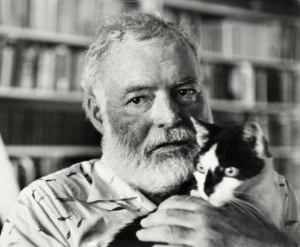
ErnestHemingwayCAT
Look at this handsome fella, with his cat! Thanks to @VLoustalot for finding this.

The Sun Also Rises is, of course, the perfect inspiration for traveling to or living in Europe. For me and a few friends it served as the backbone of our own European trip in college (a story I’m sure is true for about fifteen thousand of those trips a year). Thanks to this book, I desperately wanted to spend my life in exile in Paris and very nearly did so, but more on that in later posts.

In this post, we’re still focused on teenaged Andrew and his first experience with Jake Barnes and company. At that age, I wanted so badly to hang out with these very fun people. To drink and laugh and travel with them. To have grand adventures and loud, boisterous dinners. I wanted to fall in love with Lady Brett Ashley, with her clever short hair and her careless discarding of men. Brett is one of the first fictional characters that set me up for poor decision-making about relationships and romance.

Reading The Sun Also Rises as an adult, the only part of the book I want to join the characters for is the fishing trip in Spain with Bill Gorton. To my adult eyes, Pamplona seems like a shit-show and Paris seems dour and desperate. But on the river? They eat well, they get lots of sleep, they drink wine during the day, they catch fish. And Bill is hilarious.

I do love to read Hemingway, though and reading this was a treat. This book, For Whom the Bell Tolls, his short stories— his prose is as crisp and refreshing as the river Jake and Bill go fishing in. For some reason, though, he’s the one writer I’ve loved whose style I’ve never tried to imitate. I don’t know why. Probably I am just a bit of a rambler.

You’ve read this book already, of course. But if you, like me, let your copy slip out of your collection, buy one and have it around like a good, old friend.

Smashing Pumpkins: Mellon Collie and the Infinite Sadness

This post is in the theme “Constructing an identity through media”. Read the first.

August 26, New York: I put my headphones on and went for a walk with this album. It starts so soft with the orchestral arrangement and then the string-dominated “Tonight, Tonight”. I all but forgot I was listening to a rock album until “Jellbelly” kicked off. When this album wants to rock, it rocks. “Bullet with Butterfly Wings” caught me by surprise when all of a sudden, in my headphones, Billy Corgan stated declaratively: “The world is a vampire.” Rock ensued.

This album is pretty fucking great. I wasn’t sure how time would treat it, but it’s a good one. Wide variation and great songs. There does not seem to be much distance between hits and filler, it’s just one solid album. I remember when this album was released, the pride I felt as a fan of a band that took a big risk. That booked an orchestra to weave into their crazy-long double album. And it worked. So many hit singles from such a great total album. For a song like “Tonight, Tonight” to be in regular rotation on MTV, that’s something.

I saw Smashing Pumpkins on the tour for this record. They were fantastic. They played a giant stadium venue and they must have played for nearly two hours. The set dragged at the end, they lost themselves in a fifteen minute rock jam and people began to file out. I was there with a girlfriend and the poor friend of mine who had driven us (who found himself the very definition of a third wheel) and while the friend was desperate to leave, my girlfriend and I were determined to see the end. Wrapping up their jam and my friend checked his watch, Billy Corgan looked up to the half-empty stadium and gave us a little speech about being the real fans, and fuck ‘the MTV fans’, and then he played “Bullet with Butterfly Wings”. It’s great to see a band you love in triumph.

Buy yourself a little Mellon Collie and the Infinite Sadness.

MTV Party To Go, Vol. 5

This post is in the theme “Constructing an identity through media”. Read the first.

August 24, New York: This is a post about high school dances. And middle school dances, too. I grew up in St. Petersburg, Florida; we knew it as the Dirty South. Our anthem was “Tootsie Roll” by the 69 Boyz.


Do you remember what it was like in nineteen ninety quad?

“Tootise Roll” played at every school dance and it defined our dance culture. I don’t know what it was like in your mid-1990s high school, but we grinded. We freaked. Male and female pelvises came together and remained inseparable for the length of every song. When I later went to college, I was astonished to discover that this style of dancing was not universal. (Perhaps it was my dance partners who were astonished.) But in Florida, in the 1990s, it wasn’t “grinding” it was just “dancing”.

MTV Party to Go Volume 5 has many of the other regular tunes at those dances. Smooth slow jams like “Anniversary” and “Weak” and dance floor fillers like “Whoomp There It Is” and “Boom! Shake the Room”. “Slam”, which for no good reason other than the repetition of the title, used to inspire a mosh pit of slam dancing at every dance. And of course, that cultural high point “Come Baby Come”.

Fun fact: The first show I ever attended was K7. It was in a teenage dance club called “Sponges”, opened by local Top 40 shock jock Bubba the Love Sponge. It was open for kids from 12 to 19, and you know there were some 19 year old Floridian creep dudes making moves on 14 year old girls. “Come Baby Come” is a ridiculous song. Comically sexual. It makes you wonder if these guys had ever had sex before releasing this track. Well, at least you can understand the words; twenty years later and I still can’t decipher the lyrics to “Informer”.

Buy this album and relive a little bit of nineteen ninety quad.

Operation Ivy and Rancid: Let’s Go

This post is in the theme “Constructing an identity through media”. Read the first.

August 24, New York: My punk phase was brief, if it was a phase at all. I found my way to punk via ska, to ska via Less than Jake, whose song “Johnny Quest Thinks We’re Sellouts” was one of my absolute favorites. I saw Less than Jake a few times at St. Petersburg’s State Theater, a last bastion of the era in which the Tampa Bay area had a large and thriving punk scene. I was not a part of that scene; I was too late for that.

I guess I would be a third wave punk kid? Fourth wave? I listened to Operation Ivy and Rancid, riding around with my best friend feeling cool with the radio cranked up. The ska was great, sometimes cheerful, always danceable. I loved to skank; I’ve many times demonstrated that I could skank to any music. But Operation Ivy and Rancid always felt far cooler. More true.

These two albums were my favorites of that time. Fast, fun, rebellious. I still knew every word listening today, still enjoyed them just as much. With the perspective of over a decade gone past I heard the anti-authority message much more crisply. As a teenager, everything is anti-authority, so those messages kind of wash over you. “Fuck the cops” is what you feel you’re supposed to say. As an adult, I recognize that these were, at the time, other adults making this music. People for whom cops were a real threat and the warnings about them had to be spread far and wide.

Turn your speakers up and skank along to Operation Ivy and Rancid.

Mikhail Lermontov: A Hero of Our Time

This post is in the theme “Constructing an identity through media”. Read the first.

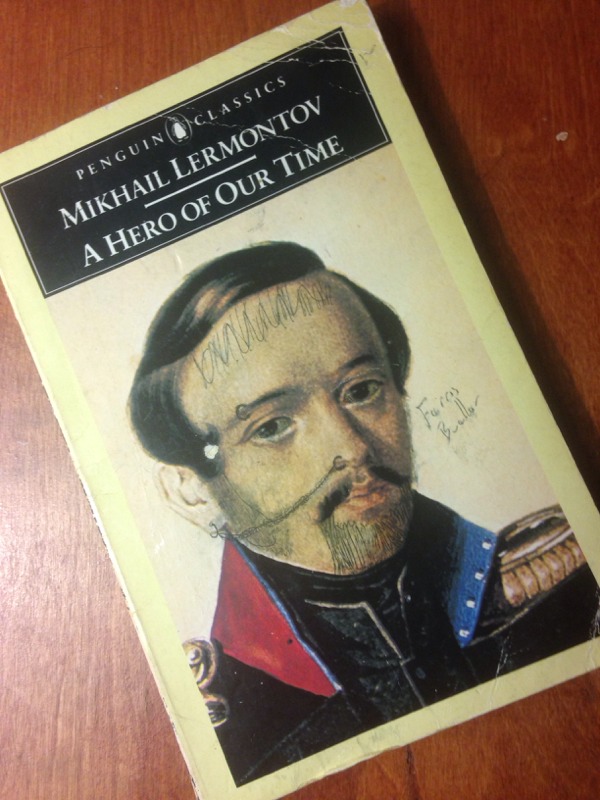
August 24, New York: I am buying new copies of many of these books. They were once owned then later lent or lost. Mikhail Lermontov’s A Hero of Our Time, for some reason, has never left my library. This slender volume has moved from Florida to Los Angeles to San Francisco to Washington to New York. And this is only the second time I’ve read it. This is my copy. Note the artful additions.

photo (24)

The first time I read this book I was a freshman in high school. In addition to my idle doodlings over Lermontov’s face, the inside cover is inscribed “Andrew Fitzgerald, Period 2”. The occasional page features deeply faded yellow highlighter.

Whoever had the idea to give this book to teenagers was a genius. Pechorin, the “Hero” of the title, is a feckless dick of a twenty-something. He’s needlessly evil from boredom, toying with the lives and emotions of others for his own amusement. He’s smart, confident, charming, and, again, a total dick. He’s basically a 1990s American teenager.

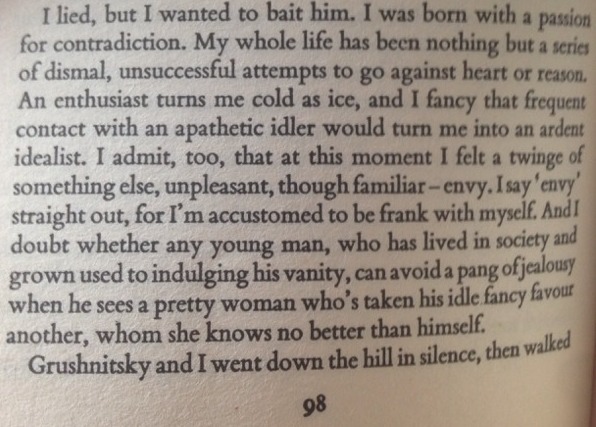
photo (25)
“An enthusiast turns me cold as ice…” What a teenage dick.

I don’t know how influential this book was on me directly, but I recognize in Lermontov’s Pechorin a persona I spent many years trying to affect. Distant, mildly amused, disaffected. (Though to be honest, I ended up less Pechorin and more Grushnitsky, the lovelorn twenty-one year old cadet who convinces himself he has an air of mystery because he wears a greatcoat.)

I included this book in this theme, because trying to be a Pechorin occupied so many years of my teens and twenties. Who didn’t want to be a smoldering Byronic Russian exiled to the Caucuses? Oh, what’s that? No one else did? Yeah, well.

Rediscover your teenage side with a trip to the Caucuses, a copy of this book in your valise.

The Gunslinger by Stephen King

This post is in the theme “Constructing an identity through media”. Read the first.

August 22, New York: In the introduction to The Gunslinger, Stephen King talks about how he was inspired by Tolkien. That he wanted to write a Tolkienesque epic, but he wanted to do it his way. And he did, spread over seven completely surreal volumes, this being one the first. I love that. That makes me adore this series even more. The Lord of the Rings infused with horror, sex, and death and cross-bred with spaghetti westerns. The books don’t feel derivative at all, but in fact feel like high post-modernity— a weaving together of sources as diverse as the Beatles and the Bible and even (especially in later volumes) King’s own books. That latter bit is fascinating to me.

The story takes inspiration from a poem by Robert Browning, which was itself inspired by a line of Mad Tom’s from King Lear: “Childe Roland to the Dark Tower Came”. Funny for me because a) I saw Lear performed for the first time this past weekend and b) I just read The Invisibles which has a whole character derived from Mad Tom. The Dark Tower series is truly epic. The universe King creates is weird and awesome. The whole Gunslinger mythos that King introduces into this world— Gunslingers as knights of their age— is a really enjoyable conceit. And the deeper you get into the books and the weirder it gets, the more you think Stephen-King-the-popular-novelist might just be Stephen-King-the-post-modern-genius.

When I first discovered The Gunslinger, I wasn’t thinking any of this. This was one of the very first adult novels I read. I pulled it down from my parents’ shelf and devoured it. This was in a period where I was taking great pride in breaking free of the young adult fare I’d been reading for so long. Length was really the only difference (and the occasional sexy scene). My pride at that age in reading a long book may have become my adult-age weakness for any doorstop of tome. I just love a ridiculously long book. And The Gunslinger, though not particularly long, was pretty adult in content.

I’ve only ever read my way through five of the seven books. It took King a long time to complete the series and once he did I kept telling myself I’d read it straight through, but have never gotten around to it. Reading the first volume was pretty fantastic though. Completing the Dark Tower series might need to be a 2015 project. Creating my own series this epic and this amazing might need to be a life goal.

You should buy and read the whole series before I do and then simmer with spoilers until 2015.